
For the past several years, a patient considering a procedure like joint replacement surgery might take steps like asking their primary care physician for a referral, consulting their insurance directory, or searching “orthopedic surgeon near me” on Google and eventually getting to your website. These days, however, many patients are changing their research approach.

With the rise of AI-powered answer engines like ChatGPT, Claude, or Perplexity, many patients are simply using these tools to do all of the research for them. What they find in those results can greatly influence their next steps, and they may not even go to your website at all before making their decision.
This is the new reality of patient acquisition, and surgical practices that don’t adapt risk becoming invisible to an entire generation of patients. Optimizing for Large Language Models (LLMs) and AI-powered answer engines is not a “nice to have” marketing tactic. It is something that you should start doing immediately.
How Today’s Patients Find a Surgeon
For the past decade or so, surgical practices relied on a few predictable channels to get new patients: physician referrals, word-of-mouth, and online searches via search engines like Google. Each of these channels rewarded practices that had strong referral relationships, a good reputation among patients, and a basic website optimized for key search terms.
Those channels are all still valid ways of acquiring patients, but AI has created a powerful new channel for patients. Patients are increasingly turning to AI tools to research healthcare decisions before they ever see a physician or visit a website.
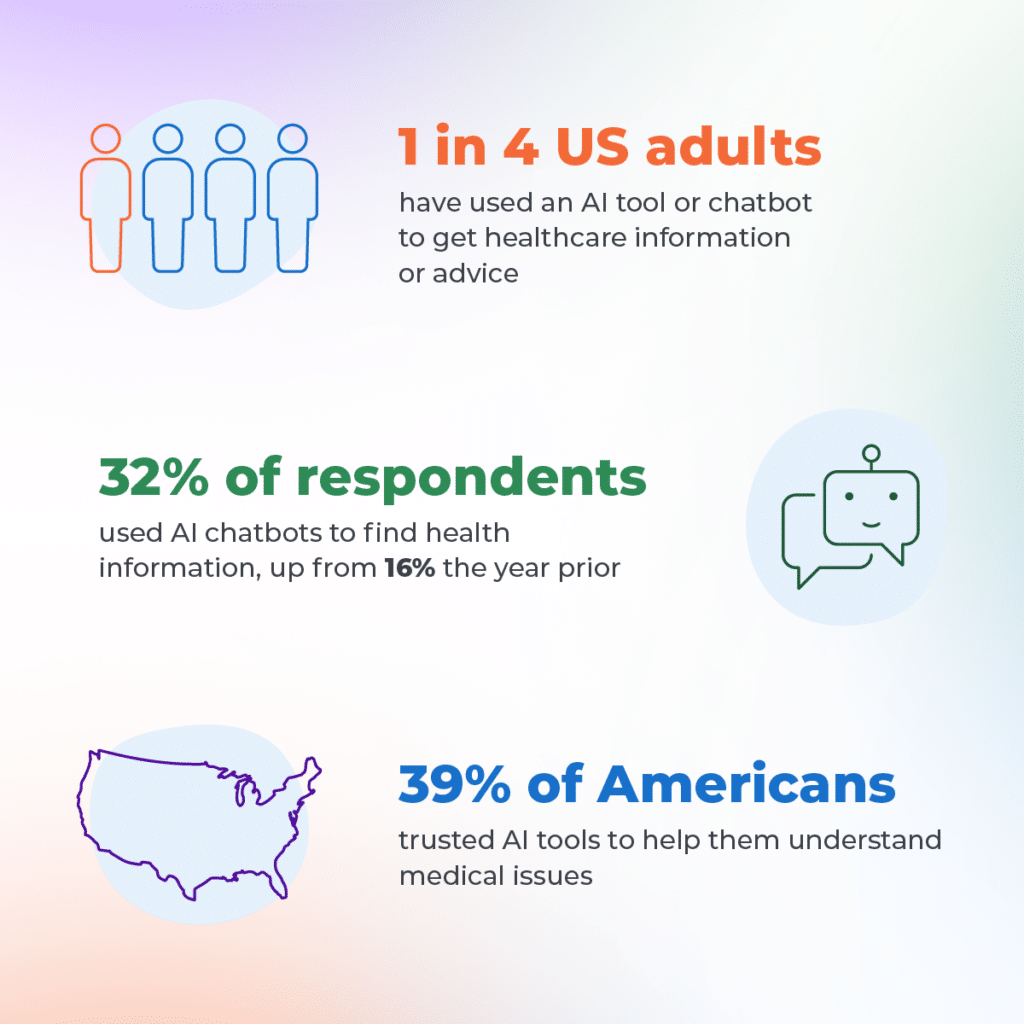
According to a 2025 West Health-Gallup survey, one in four U.S. adults (25%) have used an AI tool or chatbot to get healthcare information or advice. Of those users, more than half said they turned to AI to research on their own before or after seeing a doctor.
What’s more is that the use of AI is continuing to grow year-over-year. Rock Health’s 2025 Consumer Adoption of Digital Health Survey found that 32% of respondents used AI chatbots to find health information, up from 16% the year prior. Usage is especially high among younger generations, with 45% of Gen Z adults and 48% of Millennials using AI chatbots to find health information.
Most importantly, beyond just using AI, a lot of people trust the information they gather using these tools. A survey conducted by Drip Hydration found that 39% of Americans trusted AI tools to help them understand medical issues. Middle-aged and older adults showed a higher trust level than other generations, with nearly half of these age groups saying they trust health information from AI.
How AI-Driven Searches Can Impact Surgical Practices
This shift in patient behavior can affect patient acquisition in several ways:
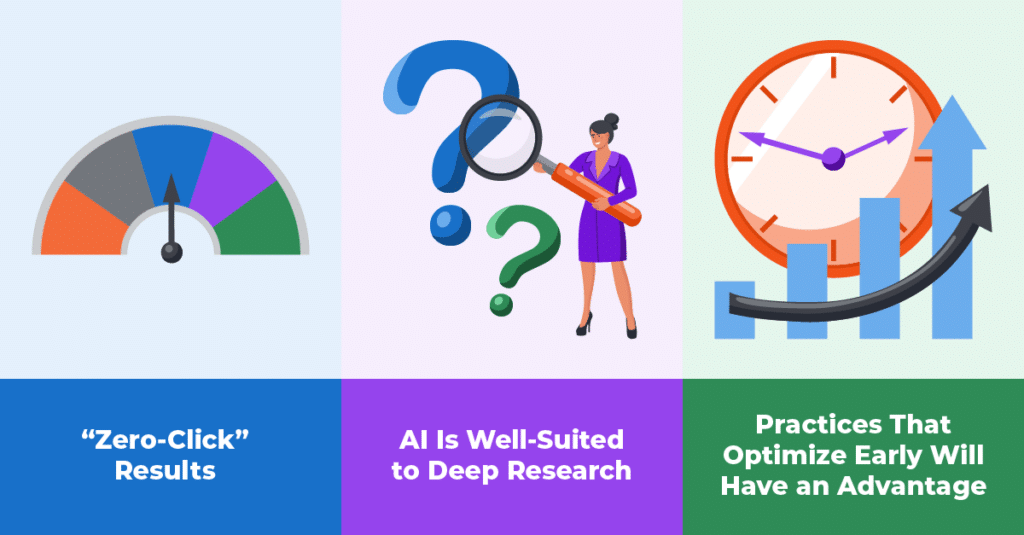
“Zero-Click” Results
Traditionally, search engine optimization for surgical practices has focused on the website as the central hub of information, and the goal is to get potential patients to go there.
However, AI results are designed to gather all of the information in one place so that people don’t have to go to several websites to get the details they are looking for. This means that patients might make a decision on which provider to see without ever going to your website. And if your name doesn’t show up at all in that AI-generated information, those patients may not even know that you exist.
AI Is Well-Suited to Deep Research
The decision to have surgery is high-stakes for patients. Risk, recovery, and cost are all major factors in surgery that cannot be discounted, and when most people need to make a high-stakes decision, they do more research. AI tools are attractive in this situation because they simplify the research process. Surgical practices that don’t consider AI optimization may fall behind as more patients use these tools before deciding to move forward with surgery.
AI is also better-suited for long-form questions than a traditional search engine. Users can be more conversational with AI and ask follow-up questions to get more information and context, which further supports the research process for a specialty procedure.
Practices That Optimize Early Will Have an Advantage
With search engine optimization (SEO), those who started early on and continued to optimize over time saw long-lasting results. However, they could still be overtaken by a competitor who put in enough time, effort, and money.
AI tools work a bit differently. With LLMs, authority compounds over time; if the AI models associate your practice’s content as an authoritative source, it typically continues to do so through each subsequent update. This means that the practices who optimize for AI early on will be much harder to outflank over time.
How Can Surgical Practices Optimize for AI Tools & LLMs?
There are several elements involved in optimizing for AI, some of which you may already be doing for search engine optimization.
It’s important to note that you shouldn’t pick and choose optimization strategies. All of these elements are needed to help you show up in AI-generated results.
1. Authoritative Original Content
Basic, thin marketing content isn’t going to cut it with AI. Neither will generic content about a procedure provided by a medical device company or patient education company. You need in-depth content that shows your unique approach to each procedure and establishes you as an authority.
For surgical practices, this includes:
- A dedicated page for each of your key procedures. Content should be a deep dive on what patients can expect, from indications and contraindications, surgical technique options, expected recovery timeline, risks and complication rates, and outcomes data. This is the kind of content LLMs will cite.
- Educational guides for before and after surgery. Patients will quiz AI tools on what to expect before and after surgery so they can properly prepare. Having this content increases the chances that your website will be cited as patients do their research.
- FAQs on each procedure page. AI-based research often follows a question-and-answer format, so structuring content around the way that patients ask questions is very beneficial in AI optimization. Think of the questions you typically get from patients, and make sure they are covered in your FAQs.
- Video content with text transcripts. Surgeon Q&A videos, procedure overviews, and patient testimonial compilations are valuable, as long as they have full-text transcripts that can be indexed by LLMs.
- Infographics with text descriptions. Visual content (perhaps illustrating anatomy or surgical approach) can be very helpful for patients, but detailed text descriptions are needed for AI to understand the information.
- Outcome and quality data. If you are able to publish outcomes data like complication rates, readmission rates, patient satisfaction scores, it can be very helpful for AI visibility. LLMs cite quantitative outcome claims because they are verifiable and specific.
2. Structured Data & Schema Markup
Schema markup is structured data added to your website’s code that makes your content machine-readable in an unambiguous format. For LLMs, this is critical.
An SE Ranking analysis found that about 71% of pages cited by ChatGPT and 65% of pages cited by Google’s AI Mode had structured data. Additionally, Microsoft has confirmed that it uses schema markup to help its LLMs understand content.
The schema types most useful for surgical practices are:
- Physician/Person Schema: Documents the surgeon’s name, credentials, board certifications, and affiliated institutions in machine-readable form
- MedicalClinic/LocalBusiness Schema: Identifies your practice as a medical facility with address, phone number, hours, and service area
- FAQPage Schema: Marks up your FAQ content in a format that maps directly to how AI retrieves answers
- MedicalProcedure Schema: Describes the specific procedures your practice offers in standardized vocabulary
- AggregateRating Schema: Surfaces your review scores in a format AI systems can parse
It’s important to note that schema doesn’t guarantee you will get cited in AI results. It just removes the friction that prevents AI from understanding your content and citing you.

3. Online Reviews
At P3, we have long touted the importance of reputation and online reviews. It’s important for traditional search engine optimization, and it’s important for AI optimization too.
Online reviews are needed in AI optimization for two key reasons:
- Review text helps AI associate you with the procedures you want to be found for. Reviews that mention surgeon names, specific procedures, and outcomes help AI understand what you do. For example, a surgeon described in dozens of reviews as “the best rotator cuff surgeon in Memphis” will have that association reinforced in AI models.
- Reviews signal trust. Review volume, recency, and average rating are quantifiable trust signals that LLMs use when assessing whether to recommend a provider.
We recommend prioritizing platforms like Google Business Profile (highest weight for local search), Healthgrades (dominant in healthcare-specific queries), Vitals, RateMDs, Zocdoc, and WebMD. Responding thoughtfully to reviews, both positive and negative, adds additional crawlable content to your profile.
4. Complete, Accurate & Consistent Local Listings
Local listings have been an important factor in SEO, and they are just as needed for AI optimization. Industry research has found that if an AI model encounters conflicting information about your practice across different platforms, it loses confidence in all of it and may exclude you entirely rather than risk presenting inaccurate information to a patient.
Listing and directory platforms to audit and maintain include Google Business, Apple Maps, Bing Places, Yelp, Healthgrades, WebMD, Vitals, ZocDoc, Bing, Facebook, Foursquare, and your insurance provider directories, which are frequently cited by LLMs for verifying in-network status.
When reviewing each listing, the following details should be identical and accurate across all platforms:
- Practice name (exact legal or DBA name)
- Address (including suite numbers)
- Phone number
- Hours of operation
- Website URL
- Provider names
5. Complete, Accurate & Consistent Professional Profiles
AI looks for verifiable external signals that a surgeon is legitimate. This is where online professional professional profiles come in. Like with local listings, your information should be complete, accurate, and complete.
Professional profiles to focus on include:
- Doximity, the professional network for physicians. This platform has a high authority level with LLMs.
- NPI Registry is an official government source that has high authority.
- Hospital system and provider pages tend to be high-authority domains. Make sure you have a full, keyword-rich bio on each applicable website.
- Professional society member directories like AAOS and others show credentialing and expertise.
- LinkedIn, while not healthcare-specific, is frequently cited by LLMs.
What Is the Cost of Ignoring AI?
Surgical practices that don’t start optimizing for AI will likely lose ground to competitors. AI use is already growing year-over-year, and patients are already using it.
Not convinced? Consider these stats:
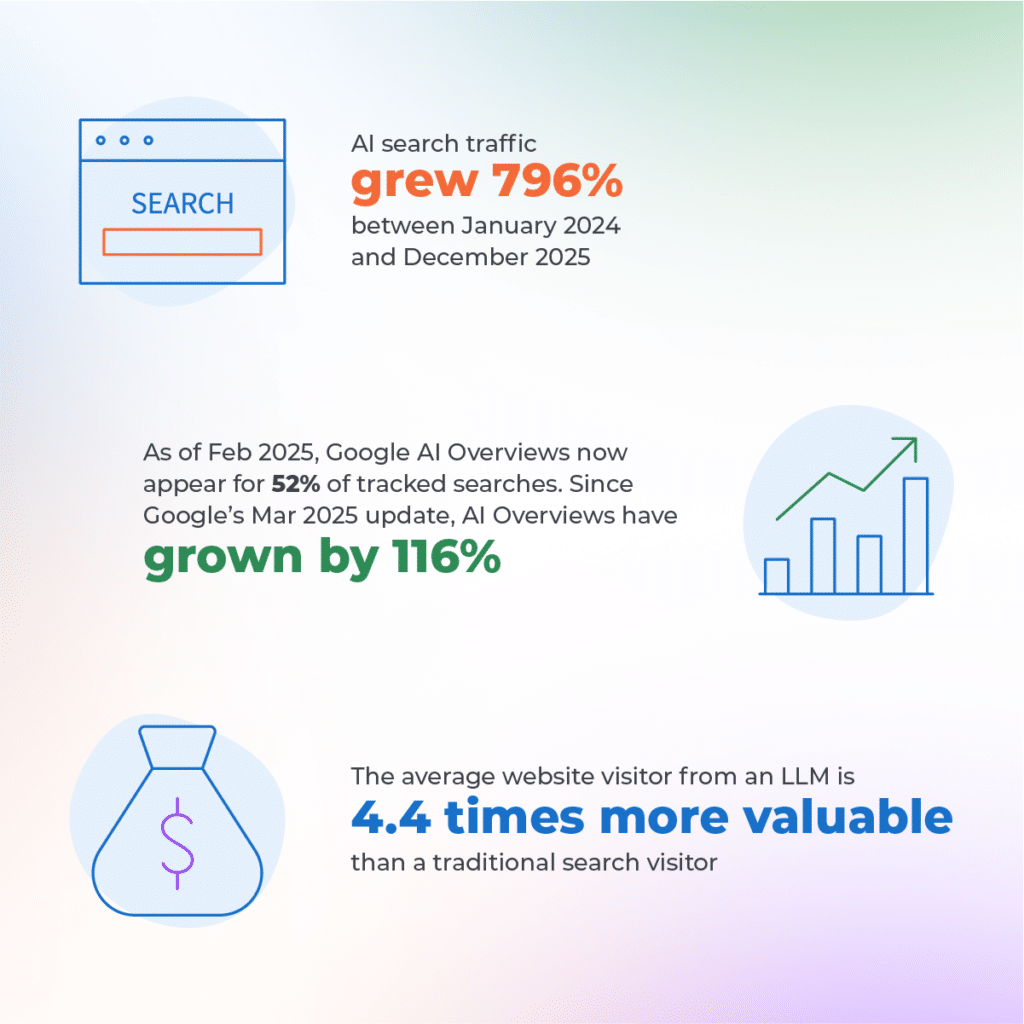
- A 2.3 billion-session analysis by WebFX found that AI search traffic grew 796% between January 2024 and December 2025.
- As of February 2025, Google AI Overviews now appear for 52% of tracked searches. Since Google’s March 2025 update, AI Overviews have grown by 116%.
- SEMRush predicts that website visits from AI search will surpass visits from traditional search by 2028. They found that the average website visitor from an LLM is 4.4 times more valuable than a traditional search visitor because they have typically already done all of the research they needed and are ready to move forward.
If you ignore or put off AI as a key component of your marketing strategy, it could affect your practice in several ways:
- Potential patients who search with AI tools may never know you exist. Failing to optimize for AI could mean that you get excluded from those results. Unlike traditional search, where patients can eventually find you if they scroll far enough, AI could leave you out completely.
- Patients get incorrect information about you. LLMs sometimes generate responses about practices based on incomplete or outdated information. Practices with incorrect listings and sparse content risk being described inaccurately by AI, creating a poor first impression before the patient ever reaches out.
- Patients may go to your competition instead. Every patient journey that begins with an AI query is a new opportunity. The practices that invest in LLM optimization now will capture that AI-driven referral stream for years.
- You miss out on compounding authority if you wait too long. Unlike traditional SEO, where a competitor can eventually be overtaken with enough effort and budget, LLM authority tends to compound. As AI models consistently associate a practice with authoritative answers on specific procedures, that association reinforces itself across future queries. The gap between early movers and late adopters widens over time.

AI optimization for surgical practices is not a radical departure from good online marketing. It is an evolution of the same core principles applied to a new and increasingly dominant channel. The practices that act now by building their content depth, cleaning up their directory data, growing online reviews, and earning third-party citations are positioning themselves at the front of the next era of patient acquisition.
Our advice? Don’t miss your window.

As the P3 Marketing Manager, Ashley ensures that our clients’ marketing strategies are put into action. This includes content writing, SEO, online advertising, analytics, and interfacing with the tools, systems, and team members needed to help our medical practice clients accomplish their marketing goals.

Scott Zeitzer
Scott has been in the healthcare industry for his entire adult life. Prior to launching P3, he earned a Master’s in Biomedical Engineering and spent 10 years selling medical devices (total hips, total knees, trauma devices, and CMF devices) to orthopedists and neurosurgeons.